
Full Mouth Reconstruction in Woodland Hills, CA
Some situations cannot be solved one tooth at a time. When decades of wear, multiple failing restorations, missing teeth, gum disease and a collapsed bite have compounded on each other, treating problems individually just moves the failure around.
Full mouth reconstruction — sometimes called full mouth rehabilitation — rebuilds the entire dentition as a single coordinated plan. It combines restorative, surgical, periodontal and cosmetic dentistry to restore function first and appearance alongside it.
Dr. Nader Ahdout graduated from the USC School of Dentistry in 1993 and has spent more than three decades doing exactly this kind of complex restorative work in Woodland Hills.
Who Needs Full Mouth Reconstruction?
- Severe tooth wear from years of grinding, acid erosion or reflux, where teeth are visibly shorter than they used to be
- Multiple failing restorations — old crowns, large fillings and bridges reaching the end of their service life at roughly the same time
- Multiple missing teeth, especially where the bite has collapsed as remaining teeth drifted
- A collapsed vertical dimension — the closed, foreshortened facial appearance that develops when back teeth wear or are lost
- Extensive decay across many teeth, often following years without care or from dry mouth caused by medication
- Advanced gum disease that has compromised the support of multiple teeth
- Trauma affecting several teeth at once
- Congenital conditions such as amelogenesis or dentinogenesis imperfecta
The Pattern We See Most Often
A patient in their fifties or sixties who has had dental work done piecemeal over thirty years. A crown here, a bridge there, several large fillings, one or two extractions never replaced. Each treatment was reasonable in isolation. Together they have produced a mouth where nothing quite fits with anything else, the bite has shifted, front teeth are chipping because they are now taking loads they were never designed for, and something new fails every few months.
That is not bad luck. It is what happens when a bite is treated as a collection of separate teeth rather than a single system.
What a Reconstruction Can Include
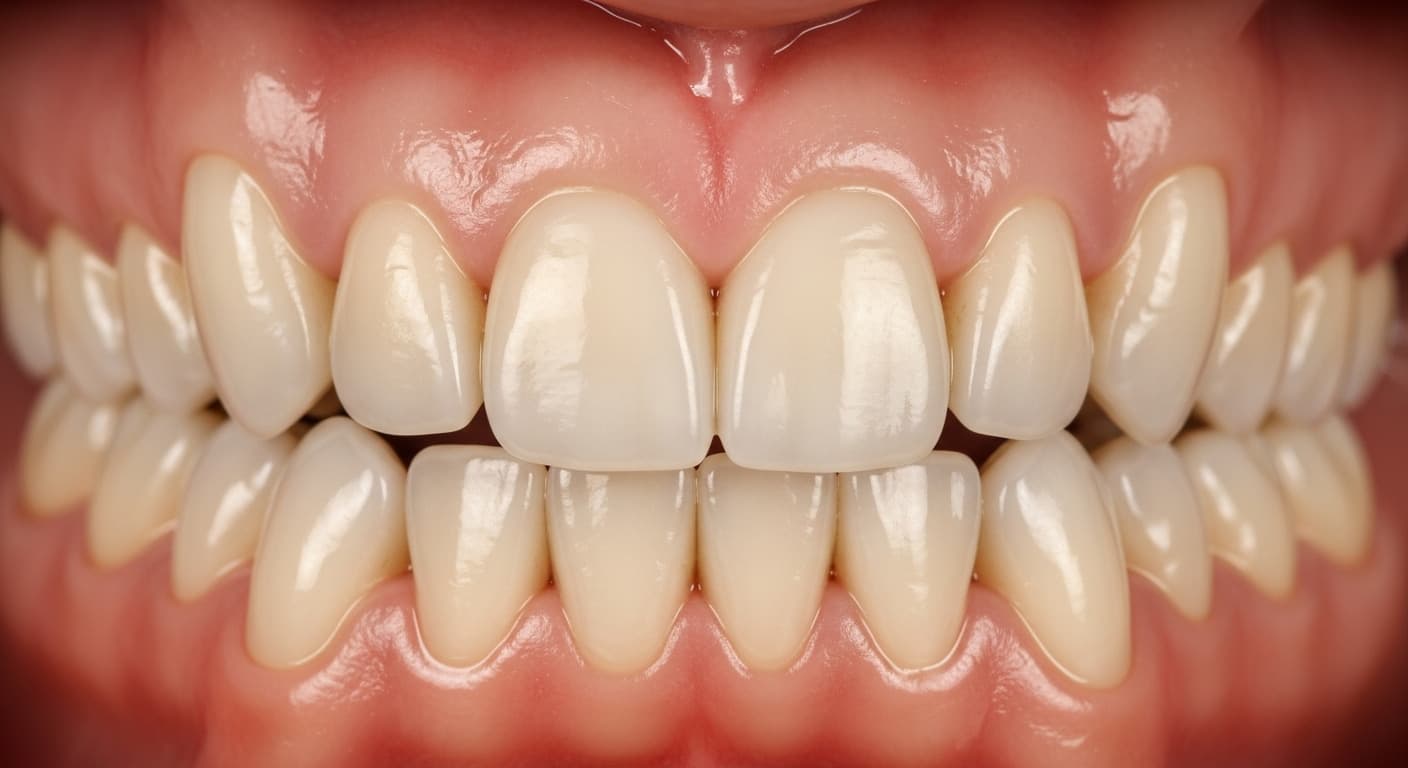
Every case is different. A plan may draw on any combination of:
- Dental implants to replace missing teeth and preserve bone
- All-on-4 or All-on-X for a full arch requiring complete replacement
- Crowns and bridges to rebuild and protect damaged teeth
- Porcelain veneers where front teeth need aesthetic correction and retain sound structure
- Root canal treatment for teeth with compromised pulp
- Periodontal therapy, including deep cleaning, to establish a healthy foundation
- Extractions and bone grafting for non-restorable teeth
- Orthodontic movement with Invisalign to reposition teeth before restoring them
- Occlusal therapy and TMJ management to stabilise the jaw joint before final restorations
- Partial or complete dentures where implants are not indicated
Why the Bite Comes First
This is what separates a genuine reconstruction from an expensive set of crowns.
Your teeth, jaw muscles and temporomandibular joints function as one system. Vertical dimension of occlusion — how far your jaw closes when your teeth meet — governs your facial height, your lip support, how your muscles work and how force distributes across every tooth.
When back teeth wear down or are lost, that dimension collapses. The lower face shortens, the chin rotates forward, folds deepen at the corners of the mouth, and the front teeth begin absorbing forces they were never built for. That is why they chip.
Restoring individual teeth without re-establishing the correct vertical dimension means building on a compromised foundation. The new restorations inherit the same destructive forces that destroyed the originals, and they fail the same way — only now the patient has paid for them.
A properly planned reconstruction determines the correct vertical dimension first, tests it, and then restores the teeth to that established position. It is the difference between rebuilding a house and repainting one with a cracked foundation.
The Process
Phase 1 — Comprehensive Diagnosis
Far more thorough than a routine examination:
- Full radiographic series and 3D imaging where implants are being considered — see our technology
- Clinical photography of your teeth, smile and face
- Periodontal charting of every tooth
- Assessment of your jaw joints, muscles and range of motion
- Analysis of wear patterns, which reveal how your bite has actually been functioning
- Digital scans and mounted study models reproducing your jaw movements
- Discussion of your medical history, medications, habits and what you want from treatment
Phase 2 — Treatment Planning and Diagnostic Wax-Up
Your models are used to design the finished result before anything is done in your mouth. A diagnostic wax-up shows the proposed shape, length and position of every tooth at the corrected vertical dimension.
You see it, and you approve it. You also receive a written, sequenced plan with costs attached to each phase — not a single intimidating figure, but a roadmap showing what happens when and what each stage costs.
Phase 3 — Stabilisation
Disease is eliminated before rebuilding begins: active decay treated, periodontal therapy completed, non-restorable teeth removed and sites grafted, endodontic treatment where needed. This phase is unglamorous and non-negotiable. Restorations placed over active disease fail.
Phase 4 — Provisional Restorations
Temporary restorations built to the design of the wax-up are placed, and this is the most underappreciated stage of the entire process.
You live in your new bite for weeks or months before it becomes permanent. You eat with it, speak with it, and your muscles and joints adapt to it. If the new vertical dimension causes discomfort, if a tooth feels high, if a sound is difficult, if you dislike the length of the front teeth — it is discovered and corrected now, in acrylic.
Every change made at this stage is straightforward. The same change after twenty units of porcelain have been fabricated is a remake.
Phase 5 — Definitive Restorations
Once the provisional design is confirmed comfortable and functional, its exact form is transferred to the laboratory and reproduced in permanent materials — porcelain, zirconia, lithium disilicate — selected for each position based on the forces it will bear and how visible it is.
Restorations are usually delivered in segments, with the bite verified at each stage.
Phase 6 — Maintenance
A reconstruction is an investment that requires protection:
- A night guard, if you grind. Not optional. Grinding forces destroyed the original teeth and will destroy the restorations
- Professional cleanings every three to six months
- Regular review of bite, joints and restoration margins
How Long Does It Take?
| Case | Typical duration |
|---|---|
| Moderate — restorations, minimal surgery | 3 to 6 months |
| Complex — implants, grafting, staged healing | 9 to 18 months |
| Extensive — multiple grafts, orthodontics, full-arch implants | 12 to 24 months |
Biology sets the pace. Implants require three to six months to integrate with bone; grafts require months to mature. You are never without teeth during treatment — provisional restorations are in place throughout.
How Much Does Full Mouth Reconstruction Cost?
Honest answer: it varies more than any other treatment in dentistry, because "full mouth reconstruction" describes a category, not a procedure.
| Scope | Typical range |
|---|---|
| Moderate — 8 to 12 units, no implants | $15,000 – $30,000 |
| Comprehensive — crowns plus several implants | $30,000 – $60,000 |
| Extensive — full-arch implants both arches | $50,000 – $100,000+ |
Cost is driven by how many teeth need treatment, how many implants are required, whether grafting is needed, the materials selected, and whether preliminary periodontal or orthodontic treatment is necessary.
How patients actually manage it:
- Insurance contributes more than people expect. Much of a reconstruction is restorative rather than cosmetic — crowns, root canals, periodontal therapy and extractions are frequently covered in part. Annual maximums cap what can be claimed per year, which is one practical reason to phase treatment across calendar years
- Phasing. Treatment is sequenced by clinical priority, so you address what is urgent first and spread the rest. Many patients complete reconstruction over two to three years
- Financing through third-party plans, frequently with interest-free periods
- FSA and HSA funds, which reset annually
We provide a written phase-by-phase plan with costs so you can see exactly what each stage involves before committing to any of it.

Is It Worth It?
For the right patient, yes — and it is worth being specific about why.
- Function returns. Patients who have avoided whole categories of food for years eat normally again
- Pain stops. Headaches, jaw discomfort and sensitivity traced to a failing bite frequently resolve when the bite is corrected
- Deterioration halts. Without intervention, a collapsing bite continues to collapse. Each additional lost tooth makes the eventual solution more complex and more expensive
- Facial appearance improves. Restoring lost vertical dimension supports the lips and lower face
- It lasts. A properly planned reconstruction, protected by a night guard and maintained, is measured in decades
And equally honestly: it is not for everyone. Patients whose problems can be solved with targeted treatment should have targeted treatment. If three teeth need crowns, we will place three crowns. A full reconstruction is indicated when the system itself has failed — not as an upsell.
Why Choose Dr. Ahdout
Full mouth reconstruction is the most demanding work in general dentistry. It requires competence across restorative, surgical, periodontal, endodontic and cosmetic disciplines, and the diagnostic judgement to sequence them correctly.
- Thirty-plus years and a USC dental education, with a career built on complex restorative cases
- Bite-first planning. Vertical dimension is established and tested before permanent restorations are made
- Provisional stage taken seriously. You approve your new bite by living in it
- Everything under one roof — implants, crowns, endodontics, extractions, veneers and prosthetics — which means one clinician holds the whole plan rather than coordinating between offices
- Phased, written, transparent costs
- Sedation options including nitrous oxide and oral conscious sedation for longer appointments
- A dental spa environment, 4.6 stars across 80 Google reviews
See completed cases in our smile gallery.
Book a Comprehensive Consultation
Full mouth reconstruction begins with a long conversation and a thorough examination — not a sales pitch. You will leave understanding what is happening in your mouth, what your realistic options are, what each would cost, and in what order things should happen.
Call (818) 340-3062 or request a consultation.
Dr. Nader Ahdout, DDS · 22116 Ventura Blvd, Woodland Hills, CA 91364

Frequently Asked Questions
How much does full mouth reconstruction cost in Woodland Hills?
It ranges widely because the term describes a category rather than a single procedure. Moderate cases of eight to twelve restorations without implants typically run $15,000 to $30,000; comprehensive cases combining crowns with several implants $30,000 to $60,000; and extensive full-arch implant cases $50,000 to $100,000 or more. Much of the work is restorative rather than cosmetic, so insurance often contributes.
How long does full mouth reconstruction take?
Moderate cases take three to six months, complex cases involving implants nine to eighteen months, and extensive cases with grafting or orthodontics twelve to twenty-four months. Biology sets the pace — implants need three to six months to integrate with bone. Provisional restorations are worn throughout, so you are never without teeth.
What is the difference between a full mouth reconstruction and a smile makeover?
A smile makeover is primarily cosmetic, improving the appearance of teeth that are fundamentally healthy, usually with veneers, bonding and whitening. A full mouth reconstruction is functional first: it rebuilds a dentition compromised by wear, decay, missing teeth or a collapsed bite, and re-establishes correct vertical dimension. Appearance improves as a consequence.
Will insurance cover any of it?
Often more than patients expect. Crowns, root canals, extractions, periodontal therapy and dentures are restorative procedures that most dental plans cover in part, though annual maximums limit how much can be claimed per year. Purely cosmetic elements such as veneers are not covered. Phasing treatment across calendar years lets you use more than one annual maximum.
Can I get everything done at once?
Not entirely, and attempting to would compromise the result. Implants need months to integrate with bone and grafts need time to mature, so those stages cannot be compressed. What can be accelerated is the restorative work, and provisional restorations mean you always have functional, presentable teeth while healing takes place.
Do I need a night guard afterwards?
If you grind or clench, yes, without exception. Grinding forces are the most common cause of the wear that made reconstruction necessary, and those forces do not disappear once teeth are rebuilt. A night guard protects the restorations from the same destructive load. It costs a small fraction of replacing fractured porcelain.
Trusted Dentist in Woodland Hills for Comprehensive Dental Care
Schedule your free consultation with Dr. Ahdout and experience high-quality cosmetic and family dentistry tailored to your smile needs.
Visit Our Woodland Hills Office
Call Now
(818) 340-3062Opening Hours
- Mon
- 9 AM – 6 PM
- Tue
- 9 AM – 6 PM
- Wed
- 9 AM – 6 PM
- ThuToday
- 9 AM – 6 PM
- Fri
- 9 AM – 1:30 PM
- Sat
- Closed
- Sun
- Closed